
Monitoring antimicrobial resistance in surface waters: experience from the Abruzzo Region
Background
Antimicrobial resistance (AMR) is one of the major global public health challenges. Although it has traditionally been investigated primarily in human and veterinary settings, increasing evidence has highlighted the importance of the environment as both a reservoir and a pathway for the dissemination of resistant bacteria, antimicrobial resistance genes and antimicrobial residues.
In recognition of the strategic role of the environment within the One Health approach, environmental monitoring was included among the actions set out in the Italian National Action Plan on Antimicrobial Resistance (Piano Nazionale di Contrasto all’Antibiotico-Resistenza, PNCAR 2022–2025). This approach acknowledges the close interdependence of human, animal and ecosystem health.
Surface waters represent a particularly relevant matrix for AMR surveillance. Watercourses may receive resistant microorganisms, antimicrobial resistance genes and antibiotic residues from numerous sources, including wastewater treatment plant discharges, agricultural and livestock activities, aquaculture and certain industrial processes. Wastewater is one of the main sources of environmental contamination, particularly when treated effluent is discharged into surface water bodies.
Wastewater treatment plants are therefore of particular interest. Although treatment and disinfection processes substantially reduce microbial loads, conventional technologies may not always be sufficient to completely remove resistant bacteria and antimicrobial resistance genes (Pruden et al., 2006). In recent years, conventional chlorine-based disinfection systems have increasingly been complemented by alternative technologies, including peracetic acid, ultraviolet radiation and ozone, partly to limit the formation of potentially harmful chlorination by-products (Regione Abruzzo, Piano di Tutela delle Acque – Elaborato 11, Norme Tecniche di Attuazione, Article 32, paragraph 10). However, these technologies also have limitations in terms of their ability to remove antimicrobial resistance determinants (Rizzo et al., 2013; Di Cesare et al., 2016; Manaia et al., 2018).
Additional concerns arise from incomplete sewerage networks, emergency discharges activated during heavy rainfall events, and the agricultural use of sewage sludge and livestock effluents. Under these circumstances, resistant bacteria, antimicrobial resistance genes and antibiotic residues may reach surface water bodies through run-off, leaching and percolation.
Despite growing scientific interest, knowledge of the distribution and dynamics of AMR in the environment remains limited compared with the evidence available from the human and veterinary sectors. Against this background, surface water monitoring provides an important tool for investigating the circulation of resistant bacteria in the environment and integrating evidence from public health surveillance and antimicrobial residue monitoring. It can therefore contribute to a more comprehensive assessment of AMR within a One Health framework.A regional monitoring system
In line with the One Health approach promoted by the Italian National Action Plan on Antimicrobial Resistance (PNCAR 2022–2025), the Abruzzo Region established a programme to monitor AMR in surface waters. This regional initiative was developed to generate data on the environmental distribution of major resistant bacteria and to contribute to the development of an increasingly integrated surveillance system encompassing the human, veterinary and environmental sectors.
The programme is implemented through collaboration between the Abruzzo Regional Agency for Environmental Protection (ARPA Abruzzo) and the Istituto Zooprofilattico Sperimentale dell’Abruzzo e del Molise “G. Caporale” (IZSAM). ARPA Abruzzo is responsible for collecting surface water samples, while IZSAM performs the microbiological analyses. The two institutions jointly interpret the results.
The design of the monitoring network was a key stage in the development of the programme. Sampling stations were selected primarily in water bodies receiving discharges from urban wastewater treatment plants, with particular attention to facilities that also treat wastewater originating from the main healthcare establishments in the region (Figure 1). This strategy focuses monitoring activities on locations where resistant bacteria discharged into the environment are most likely to be detected.
The network comprises nine stations distributed across the region. With the exception of one site in the Province of Chieti, all sampling points coincide with stations already included in the regional surface water monitoring network used to assess the ecological and chemical status of water bodies. Integration with an established monitoring network optimises surveillance activities and allows microbiological data relevant to AMR surveillance to complement the environmental information routinely collected.
The sampling sites are located immediately downstream of the selected wastewater treatment plant discharges, thereby allowing the presence of resistant bacteria in the receiving waters to be assessed. The geographical distribution of the monitoring stations across the Abruzzo Region is shown in Figure 1.
Figure 1. Location of the surface water sampling sites included in the antimicrobial resistance monitoring programme
What is monitored
Surveillance activities focus on the detection of selected microorganisms considered to be indicators of the environmental spread of antimicrobial resistance.
The following microorganisms are investigated:
- extended-spectrum β-lactamase-producing Escherichia coli (ESBL-producing E. coli), as an indicator of resistance to third-generation cephalosporins;
- carbapenem-resistant Escherichia coli (CRE), as an indicator of resistance to antimicrobials regarded as last-resort treatment options;
- vancomycin-resistant enterococci (VRE), which are of particular relevance because of their role in healthcare-associated infections;
- Klebsiella spp., which include major opportunistic pathogens associated with the spread of multidrug-resistant strains.
From sampling to laboratory analysis
Surface water samples are collected by ARPA Abruzzo personnel using sterile one-litre polypropylene containers attached to a telescopic pole to ensure safe sampling. Samples are collected a few centimetres below the water surface, kept refrigerated during transport and delivered to the laboratory within a few hours of collection. Microbiological testing is initiated within 24 hours, in accordance with the procedures required to ensure the reliability of the results.
Samples are analysed using membrane filtration, which concentrates the bacterial component present in the water. The membranes are subsequently transferred onto selective and differential culture media supplemented with specific antimicrobials. These media promote the growth of resistant microorganisms and provide an initial estimate of their concentration in the samples. Reference bacterial strains are also included in each analytical session for quality control purposes.
Following incubation, colonies displaying morphological characteristics consistent with the target microorganisms are isolated and identified by matrix-assisted laser desorption/ionisation time-of-flight mass spectrometry (MALDI-TOF MS), a technique widely used in microbiology laboratories for the rapid and accurate identification of bacterial species.
Identification is followed by antimicrobial susceptibility testing using the agar disc diffusion method, in accordance with the international standards established by the European Committee on Antimicrobial Susceptibility Testing (EUCAST) and the Clinical and Laboratory Standards Institute (CLSI). This stage confirms the phenotypic resistance profiles of the isolates and verifies that growth on the selective media is genuinely associated with the resistance characteristics under investigation.
For the detection of Klebsiella spp., the protocol includes an initial culture-enrichment stage, followed by isolation on selective media and subsequent identification by MALDI-TOF MS. In this case, the result is reported as the presence or absence of the microorganism in the sample.
The methods used are based on standardised and validated microbiological procedures, an essential requirement for ensuring the quality of the results and their comparability over time. Standardisation is also fundamental to the potential extension of the monitoring programme to other geographical areas and to the development of harmonised surveillance systems at national level. The analytical workflow, from sample collection to the reporting of results, is illustrated in Figure 2.
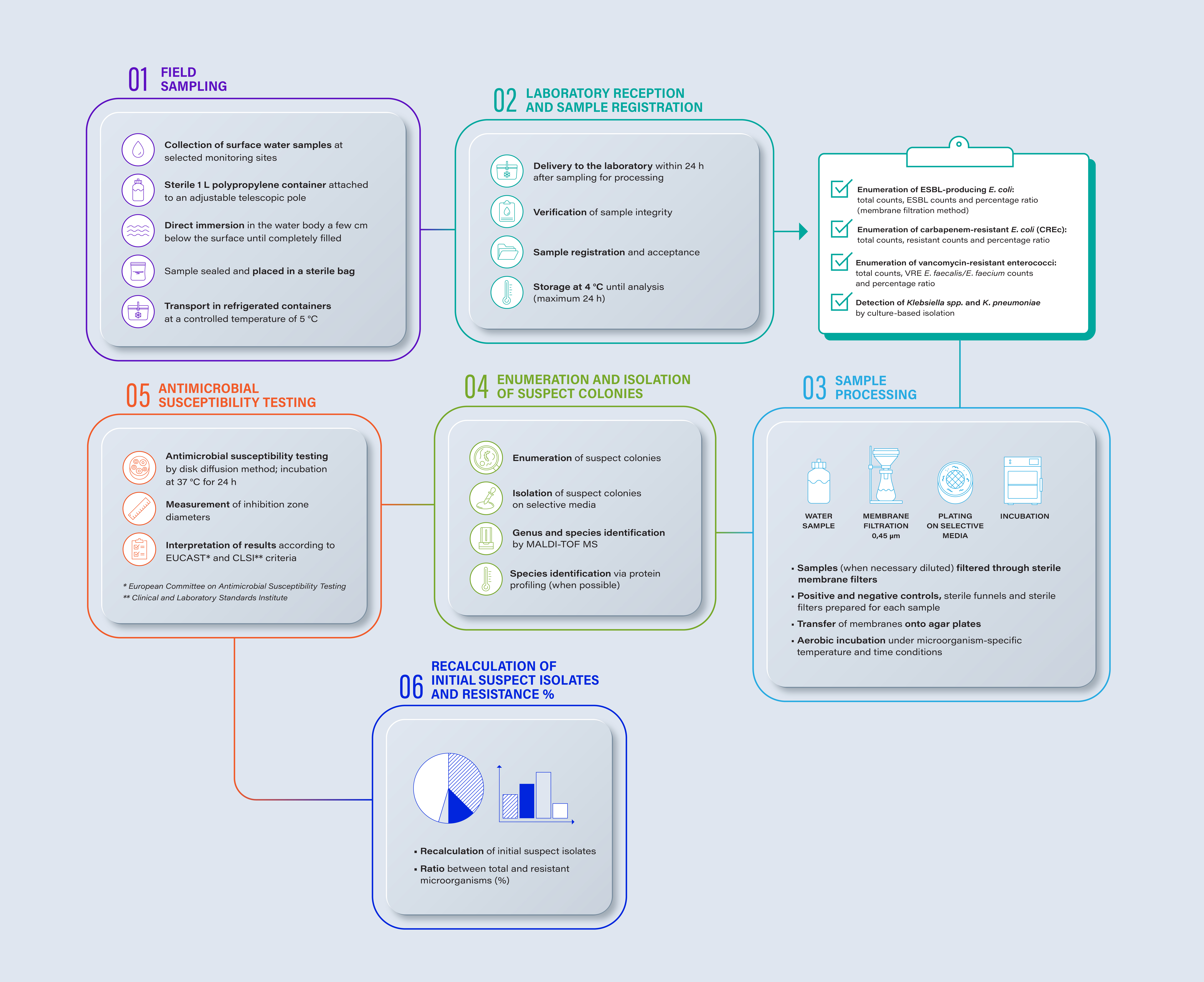
Figure 2. Schematic overview of the workflow for surface water sampling, microbiological analysis and antimicrobial resistance assessment
Strengths and limitations
One of the programme’s main strengths is the integration of ARPA Abruzzo’s environmental expertise with IZSAM’s microbiological expertise. This collaboration has enabled the development of a monitoring system based on shared procedures and an established sampling network.
Nevertheless, some operational limitations remain. The requirement to analyse samples within 24 hours of collection calls for efficient logistical arrangements, while the characteristics of environmental matrices may complicate membrane filtration and microbiological isolation. A high background microbial load may also interfere with the growth of target microorganisms, making it essential to confirm both bacterial identification and resistance profiles using microbiological and instrumental techniques.
Despite these limitations, the protocol generates reliable and comparable data and provides a robust basis for monitoring temporal changes in antimicrobial resistance in surface waters and for progressively strengthening environmental surveillance within a One Health framework.Conclusions
The experience of the Abruzzo Region demonstrates that an environmental AMR surveillance system can be successfully developed by drawing on collaboration between institutions responsible for protecting public health and the environment.
Surface water monitoring does not replace surveillance activities in the human and veterinary sectors or the monitoring of antimicrobial residues; rather, it complements these activities and contributes to a broader understanding of the spread of AMR within a One Health framework. The long-term consolidation of this monitoring system will make it possible not only to describe the occurrence of resistant bacteria in regional water bodies, but also to monitor changes over time, identify emerging trends in resistance profiles and support future prevention and control strategies.References
- Di Cesare A., Eckert E.M., D’Urso S., Bertoni R., Gillan D.C., Wattiez R., Corno G., 2016. Co-occurrence of integrase 1, antibiotic and heavy metal resistance genes in municipal wastewater treatment plants. Water Res. May 1:94:208-214. doi: 10.1016/j.watres.2016.02.049. doi: 10.1016/j.envint.2018.03.044
- Manaia C.M., Rocha J., Scaccia N., Marano R., Radu E., Biancullo F., Cerqueira F., Fortunato G., Iakovides I., Zammit I., Kampouris I., Vaz-Moreira I., Nunes O.C., 2018. Antibiotic resistance in wastewater treatment plants: Tackling the black box. Environment International, 115: 312–324. doi: 10.1016/j.envint.2018.03.044
- Pruden A., Ruoting P., Storteboom H., Carlson K.H., 2006. Antibiotic Resistance Genes as Emerging Contaminants: Studies in Northern Colorado. Environ. Sci. Technol., 40, 7445-7450
- Rizzo L., Manaia C., Merlin C., Schwartz T., Dagot C., Ploy M.C., Michael I., Fatta-Kassinos D., 2013. Urban wastewater treatment plants as hotspots for antibiotic resistant bacteria and genes spread into the environment: a review. Sci. Total Environ. Mar 1:447:345-60. doi: 10.1016/j.scitotenv.2013.01.032.
Pierpaolo Piccone
ARPA Abruzzo, Distretto Provinciale di Teramo. Sezione di “Biologia e Tossicologia Ambientale, Epidemiologia Ambientale. Laboratorio di riferimento alimenti”
Alice Marchegiano
Istituto Zooprofilattico Sperimentale dell'Abruzzo e del Molise "G.Caporale", sede di Lanciano
Federica Di Timoteo
Istituto Zooprofilattico Sperimentale dell'Abruzzo e del Molise "G.Caporale", Teramo,
Batteriologia e Sviluppo Antigeni Batterici
